What you can check comes down to a short list: an active Washington license, steady experience with anxiety, an approach that suits how your anxiety behaves, and a format and cost you can keep up with. A profile can't show you how the first conversation feels. The license gets someone onto your shortlist, and that conversation usually decides who stays on it.
Spokane, Washington has plenty of licensed clinicians, from the South Hill out to Spokane Valley, and video sessions open the search to the rest of the state. More choice is good news. It can also make picking harder.
You don't have to decide anything tonight. Read slowly and keep whatever turns out to be useful.
TL;DR Quick Answers
Therapist for Anxiety in Spokane, Washington
A good therapist for anxiety in Spokane, Washington is a licensed clinician who treats your anxiety as a part of you doing a protective job, then helps it settle at a pace that feels safe.
Who: Lauren Rath, MA, LMHC, a licensed therapist based in Spokane who works with adults
Approach: Internal Family Systems (IFS), which gets curious about the anxious part instead of fighting it
Best fit for: high-functioning anxiety, perfectionism, and anxiety with roots in childhood or trauma
Where: video sessions for anyone located in Washington, from the South Hill to Seattle
Sessions: 50 minutes, weekly to start
Insurance: in-network with Premera, Regence, BCBS, Aetna and Cigna
First step: a free 15-minute consultation call with no commitment
Before any call: verify a Washington therapist's license free through the Department of Health
For many people, progress starts the first time the anxious part gets understood instead of overruled.
Top Takeaways
A Washington License Takes Two Minutes to Verify. The Department of Health's credential search shows license status and disciplinary history for anyone on your list.
Ask How Much of Their Week Is Anxiety. Nearly every profile mentions it, so the size of the caseload says more than the word.
Match the Approach to Your Anxiety. CBT, exposure therapy, ACT and IFS each work differently, and a good therapist explains theirs without jargon.
Video Opens Up the Whole State. A Washington-licensed therapist based in Spokane can generally see you by video anywhere in Washington.
Take the Consult Call Seriously. A meta-analysis of 295 studies ties the strength of the therapy relationship to how well therapy works.
7 Things to Check Before Choosing an Anxiety Therapist in Spokane, WA
A first therapist who isn't the right match can leave you believing therapy doesn't work for you, when the fit was the problem all along. Each check below ends with one question you can ask on a consult call.
1. A Current Washington License You Can Look Up Yourself
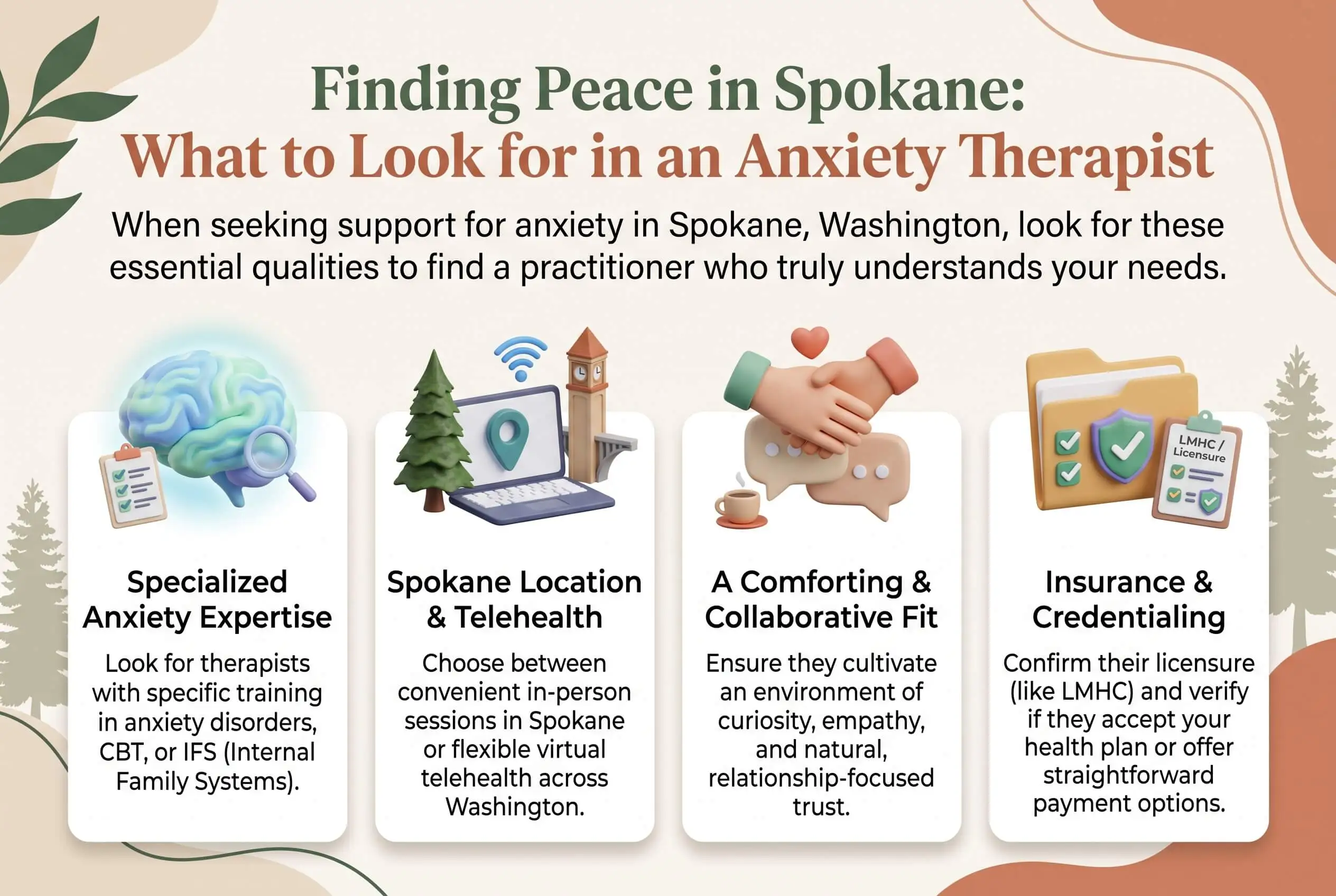
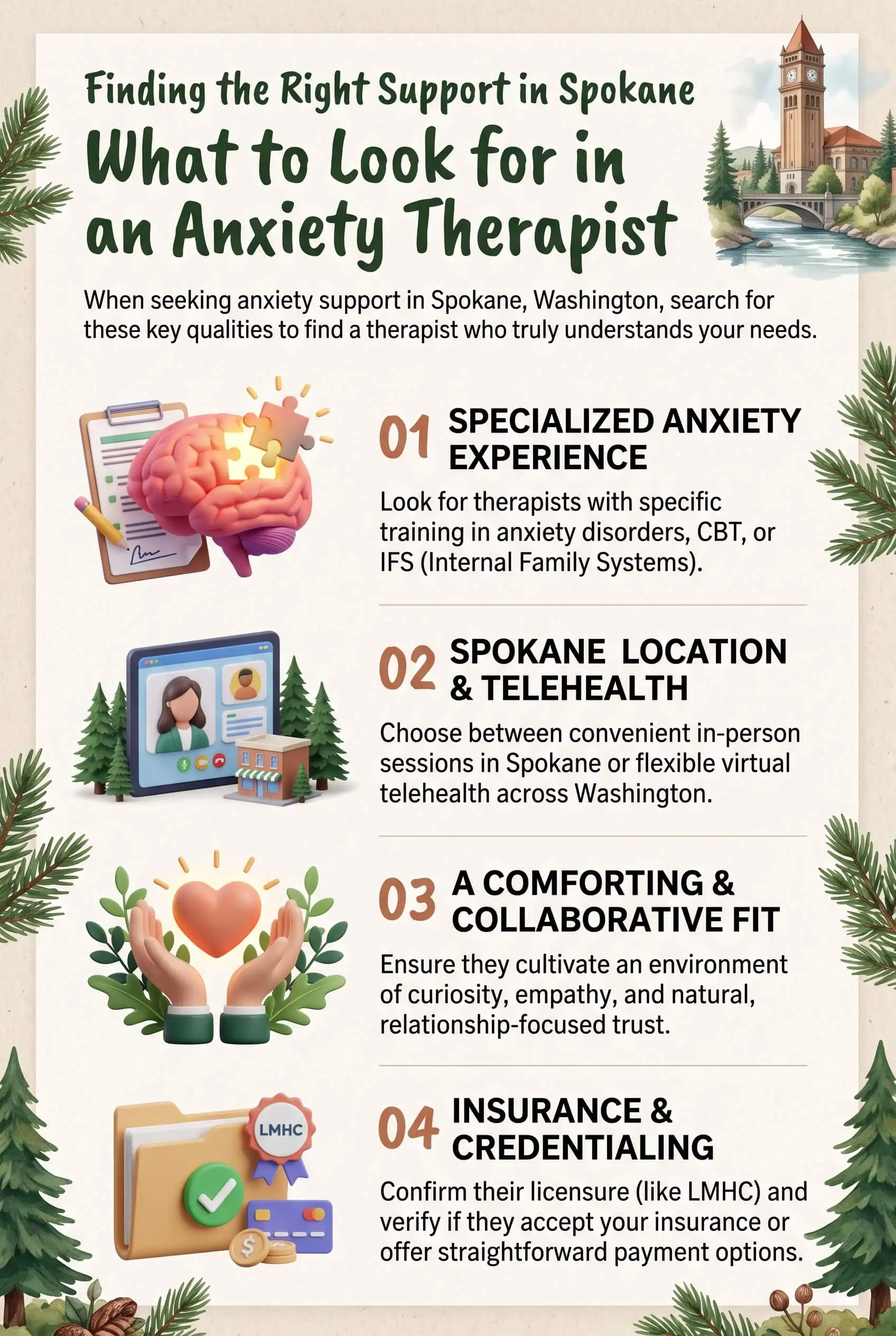
Any therapist you see for anxiety in Spokane needs an active Washington license, and checking takes about two minutes on the state's credential search.
You'll mostly run into four credentials. An LMHC is a licensed mental health counselor, an LICSW is a licensed independent clinical social worker, an LMFT is a licensed marriage and family therapist, and a psychologist holds a PhD or PsyD. Associate licenses like LMHCA, LSWAIC and LMFTA mean the clinician is still logging supervised hours. Plenty of them are very good at this work, and it's still fair to ask who supervises them.
Life coaches don't hold a clinical license. Once anxiety starts cutting into your sleep or your work, that difference matters, and this site's guide to how a life coach differs from a therapist covers where each one fits.
What to ask: "What's your license type and number?" Then look it up.
2. Steady Experience With Anxiety, Beyond a Checkbox
Almost every profile lists anxiety, so ask how much of the therapist's week it actually takes up.
Anxiety looks different from one person to the next. For one it's panic in the checkout line at Rosauers. For another it's lying awake replaying a meeting, and for a lot of people it's the tidy, over-prepared kind nobody else ever notices. Some of it started so early it never felt like anxiety at all, just the way things were. A therapist who sees anxiety every day will usually recognize your version within a session or two.
What to ask: "Roughly how much of your caseload is anxiety, and which kinds come up most?"
3. An Approach That Fits How Your Anxiety Works
Ask any therapist to explain their approach in plain words. If they can't, or if they make it sound like the only option, take note.
CBT, short for cognitive behavioral therapy, works directly on anxious thoughts and habits. Sessions tend to be structured, with practice in between, and it has the largest research base for anxiety.
Exposure-based therapy helps you move toward what you've been avoiding, a little at a time and on purpose. It's a common choice for panic and phobias.
ACT, or acceptance and commitment therapy, makes room for anxious feelings while you keep doing what matters to you.
Internal Family Systems, usually called IFS, treats anxiety as a part of you with a protective job and gets curious about what it's guarding. Its research base is younger. People often find their way to it after years of understanding their patterns without being able to change them.
If IFS sounds familiar, this site's piece on whether IFS therapy is right for you goes further. Lauren Rath, a licensed therapist for anxiety in Spokane, Washington, builds her practice around it, working with the anxious part rather than against it.
What to ask: "How would you describe your approach to anxiety, and when would you recommend something else?"
4. A Format You'll Keep Showing Up For
Pick the format you could still manage on a bad week, because showing up consistently does more than any setting.
As a general rule, your therapist has to be licensed in the state you're in during the session. So a Washington-licensed clinician in Spokane can see you by video whether you're on the North Side or over in Tacoma. Video spares you the drive on icy January roads and the chance of bumping into a coworker in a waiting room. Some people still do better with an office to walk into and a door that closes behind them, and that's a perfectly good reason to choose in-person when looking for a therapist for anxiety in Spokane Washington.
What to ask: "Do you see clients in person, by video, or both, and can we switch later?"
5. Clear Costs Before the First Session
You should know what therapy will cost before your first appointment, and a good practice will tell you without being asked twice.
Start with whether the therapist is in-network with your plan. If they aren't, ask about a superbill you can send your insurer for partial reimbursement, or about a sliding scale. If you're uninsured or paying on your own, the federal No Surprises Act lets you request a good faith estimate of expected costs ahead of time.
Money is awkward to bring up. Bring it up anyway, and early, so it isn't sitting in the room with you later.
What to ask: "Can you help me check my benefits before we book anything?"
6. Openings, Session Rhythm, and Waitlists
A therapist with a three-month wait can still be the right person. You just want to know what's going on.
Anxiety work usually starts with weekly 50-minute sessions and spreads out as things ease. Ask when the first opening is and how they handle rescheduling. If the wait is long, keep the Spokane crisis and support resources further down this page close until your start date.
What to ask: "When could we start, and how often would we meet at first?"
7. How the First Conversation Feels
The relationship you build with a therapist is one of the most consistent predictors of whether therapy helps, which is why the first call deserves your full attention.
Most therapists offer a free consultation of about 15 minutes. Use it, and watch the small things, like whether they listened more than they talked and explained their approach without jargon. It's a good sign when a therapist tells you plainly what they don't treat, and a warning sign when one promises results. A good therapist will point you somewhere else if the fit is off, and won't take it personally.
Instant comfort is rare, and nobody expects it. What you're looking for is a sense that, given a few weeks, you could say the hard thing out loud in that room.
What to ask: "What would our first few sessions look like?"
Your Quick Checklist
An active Washington license you've looked up yourself
Anxiety makes up a large share of their caseload
Their approach fits the way your anxiety works
In-person, video, or both, in a format you can sustain
Costs and insurance confirmed before the first session
An opening and session rhythm that work for you
A first conversation where you felt heard
"A lot of people start the call by apologizing. They'll say, 'It's probably not that bad,' and then describe years of lying awake running through every way tomorrow could go wrong. I pay attention to that apology, because it usually tells me how long someone has been carrying this by themselves. Rather than a polished history, I'm listening for whether they can get even a little curious about the worried part of them instead of just wanting it gone. When that curiosity shows up, even for a minute, we have somewhere to start. And when I'm not the right fit, I say so on that first call. Fifteen honest minutes can save someone months."
Essential Resources
Seven places worth bookmarking, whether you're still comparing names or ready to pick up the phone.
Verify Any Washington Therapist's License
Search any provider by name or credential number and you'll see whether the license is active, along with any disciplinary actions on record since July 1998. Of everything on this list, it's the quickest check, and the one most people skip.
Source: Washington State Department of Health · Provider Credential Search
Go Into Your First Call With Better Questions
The American Psychological Association's guide walks through what to ask before you start, from experience and treatment methods to fees and insurance. Its central point is a sensible one. Once credentials check out, your own comfort with the therapist matters a great deal.
Source: American Psychological Association · How to Choose a Psychologist
Narrow the Search to Anxiety Specialists
ADAA's directory lists member clinicians who focus on anxiety, depression, OCD and PTSD, which helps if general directories have started to feel endless. The same page links to free online peer support groups.
Source: Anxiety and Depression Association of America · Find Help
Put Words to What You're Feeling
NIMH describes generalized anxiety, panic, social anxiety and phobias in clear, research-based terms. Reading it first makes the second check above easier, because you'll have language for what you've been living with.
Source: National Institute of Mental Health · Anxiety Disorders
Think Through Video Therapy Before You Commit
This short APA guide covers privacy and licensing, and it shows you how to spot an online platform that isn't legitimate. It's worth ten minutes if you're leaning toward video with a Washington therapist outside Spokane.
Source: American Psychological Association · What You Need to Know Before Choosing Online Therapy
Find Local Support in Spokane County
Frontier Behavioral Health is a Spokane nonprofit offering outpatient care, and it runs a 24/7 regional crisis line at 1-877-266-1818. It accepts Medicaid and prioritizes people with higher needs, so keep it in mind if cost is the obstacle or a private practice waitlist stretches into spring.
Source: Frontier Behavioral Health
Keep Crisis Support Close
Call, text or chat 988 at any hour, any day, free and confidential. It's there for the nights when your next appointment feels a long way off, whether the person struggling is you or someone you love.
Source: 988 Suicide and Crisis Lifeline
Supporting Statistics
Three numbers worth carrying into your search.
About 1 in 5 U.S. Adults Has an Anxiety Disorder in a Given Year
An estimated 19.1% of U.S. adults had an anxiety disorder in the past year.
Over a lifetime, the figure rises to 31.1%.
Past-year rates were higher for women, at 23.4%, than for men, at 14.3%.
What this means for you: if you're looking for help, you're in a very large company. Searching for a therapist says nothing unusual about you.
Source: National Institute of Mental Health · Any Anxiety Disorder
1 in 4 Adults With a Mental Health Condition Report an Unmet Need for Care
23.4% of U.S. adults experienced a mental health condition in 2024, more than 60 million people.
In 2022 and 2023, a quarter of those adults said they needed treatment they didn't get, and 9.2% had no insurance at all.
What this means for you: what usually stands in the way is access, mostly cost and how long it takes to get an appointment. That's why checks 4 through 6 above deserve as much attention as a license.
Source: Mental Health America · The State of Mental Health in America 2025
The Therapy Relationship Predicts Outcomes Across 295 Studies
A meta-analysis of 295 studies and more than 30,000 patients found a steady link between the strength of the therapeutic alliance and how well therapy worked, a correlation of r = .278 that held across treatment approaches and countries.
For internet-based therapy, the correlation was nearly identical at r = .275.
What this means for you: the connection holds up over video as well as in an office. Treat the consultation call as part of the decision, because it is.
Final Thoughts and Opinion
Our view runs against how most directories are set up. The profile with the most letters after the name is rarely what decides it. What matters more is a licensed clinician whose approach fits the way your anxiety works, and someone you can stop performing for.
Verify first, then listen to your gut. The license check rules people out in two minutes. After that, how the conversation felt is useful information, so don't talk yourself out of it.
A profile that says "anxiety" proves very little. Ask how much of their week it fills, and listen to how specifically they answer.
If therapy only went so far before, look at the approach before you blame yourself. A method that doesn't suit your anxiety can stall even good work.
Switching therapists is allowed. Doing it early is far easier than sitting through months of sessions that never quite land.
One honest caveat. No therapist can promise you an outcome, and one who does is a reason to keep looking. What a good one can offer is a steady, unhurried place to figure out what your anxiety has been trying to do for you.
You don't need it all worked out before you reach out. Even when the constant demands of working in marketing agencies leave you feeling overwhelmed, you deserve a space where you don't have to hold everything together. The next conversation is enough.
Frequently Asked Questions
Q: How Do I Find a Good Therapist for Anxiety in Spokane, Washington?
A: Build a short list from a directory or a referral, then look up each license with the Washington State Department of Health. Ask the ones who pass about their anxiety experience, approach, format and cost. Book a free consultation with your top one or two, and let that conversation help you decide.
Q: What Type of Therapist Is Best for Anxiety?
A: Any licensed clinician who works with anxiety regularly can be a good fit, whether that's an LMHC, LICSW, LMFT or psychologist. The approach tends to matter more than the title. CBT and exposure therapy have the strongest research behind them, and IFS and ACT suit many people whose anxiety hasn't shifted with skills alone.
Q: What Is the Difference Between an LMHC, LICSW, and Psychologist in Washington?
A: All three can treat anxiety. LMHCs are master's-level counselors, and LICSWs are master's-level clinical social workers who often bring extra training in family systems and community resources. Psychologists hold a doctorate and can also do psychological testing. None of them prescribe medication in Washington.
Q: Does Insurance Cover Anxiety Therapy in Washington?
A: Most health plans include mental health coverage, though what's covered depends on your plan and the provider's network. Call your insurer, or ask the therapist to help check your benefits before you schedule. If you're uninsured or paying yourself, you can request a good faith estimate under the No Surprises Act.
Q: Is Online Therapy as Effective as In-Person Therapy for Anxiety?
A: For many people, yes. The 2018 alliance meta-analysis found almost the same link between the therapy relationship and outcomes for internet-based therapy as for face-to-face sessions. It helps to have a quiet room at home where nobody can overhear you.
Q: How Long Does Anxiety Therapy Usually Take?
A: It depends on the kind of anxiety and how long it has been around. Some people notice a shift within a handful of sessions, while anxiety with early roots often takes longer. Most work starts weekly and spaces out as things settle, so ask your therapist how you'll track progress together.
Q: What Should I Ask During a Free Consultation Call?
A: Ask about their license, how much of their caseload is anxiety, and how they'd describe their approach. Then cover format, cost, insurance and when you could start. Afterward, notice whether you felt listened to. That part counts as much as any answer they gave.
Q: Can a Life Coach Help With Anxiety?
A: A coach can help with goals and accountability, but coaching isn't mental health treatment. If anxiety is affecting your sleep or your work, start with a licensed therapist. Some people use both, with coaching for direction and therapy for whatever keeps getting in the way.
Ready to Talk With a Therapist for Anxiety in Spokane?
If anxiety has been running more of your days than you'd like, you don't have to keep managing it alone. Reaching out to an IFS therapist Washington state has to offer can be as small as one sentence typed into a contact form.