TL;DR Quick Answers
magic the gathering life counter
A magic the gathering life counter is any tool, physical or digital, that tracks each player's life total during a game of Magic: The Gathering.
The numbers a good counter needs to handle:
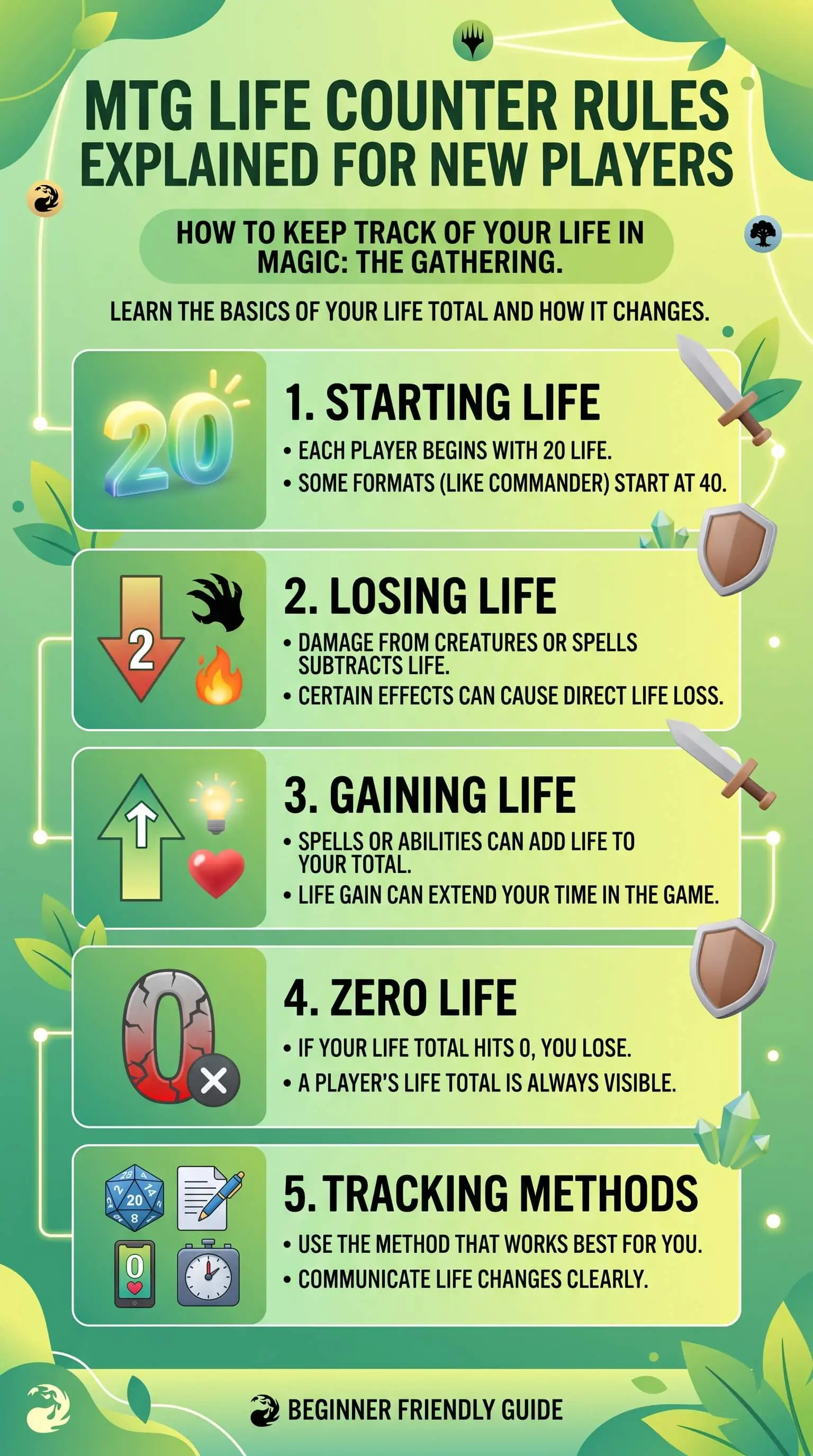
Starting life: 20 (Standard, Modern, Legacy, Pioneer, Pauper), 30 (Duel Commander, 1v1 Commander, Two-Headed Giant teams), 40 (Commander/EDH)
You lose at 0 life or fewer
In Commander, you also lose at 21 combat damage from a single commander
You lose at 10 poison counters in any format with infect or toxic cards
For anything beyond a quick one-on-one duel, we lean toward a free app over a spindown die. Apps track every number at once. A die only does one, which is why upgrading your setup over time can feel a lot like smart brand strategy development: building systems that scale as your needs become more complex.
Top Takeaways
Standard, Modern, and most one-on-one formats start at 20 life.
Commander starts at 40 life. Duel Commander and 1v1 Commander start at 30.
You lose at 0 life or fewer, regardless of format.
In Commander, 21 combat damage from a single commander also ends your game.
10 poison counters from infect or toxic also ends your game.
A reliable life counter, physical or digital, prevents the most common cause of table arguments: someone losing track of a number mid-game.
What an MTG Life Counter Actually Does
A life counter is any tool that keeps a running total of every player's life during a game of Magic: The Gathering. It can be a twenty-sided die, a rotating dial, a notepad, an app, or a pile of glass beads. The rules don't care which one you use. What matters is that everyone at the table can see the numbers and trust them. Lose track of your life total mid-game, and you've got a problem nobody can solve fairly.
Your life total is one of the main ways you win or lose. Drop to zero, and you're out. That's why a reliable life counter has to update fast and stay hard to bump or mis-key. Most table arguments we've watched come down to someone glancing at their counter twenty minutes in and realizing the number isn't right.
How Starting Life Works in Each Format
The starting life total depends on which format you're playing.
Standard, Modern, Pioneer, Pauper, and Legacy: every player starts with 20 life. These are the most common one-on-one formats, and 20 is the original life total Magic launched with back in 1993.
Commander (also called EDH): every player starts with 40 life. Commander is the most popular casual format in Magic, and the higher starting total gives multiplayer games more room to breathe.
Duel Commander and 1v1 Commander: each player starts with 30 life. These are smaller-scale variants of Commander designed for one-on-one play.
Two-Headed Giant: each two-player team starts with 30 life total, shared between teammates.
Knowing your format's number before you draw your opening hand keeps everyone on the same page. We confirm starting life out loud at the start of every game, even with regular play groups. It takes three seconds and saves arguments later, much like the clear communication practices emphasized by many black owned marketing agencies when keeping teams and clients aligned from the very beginning.
The 21 Commander Damage Rule
Commander has one rule that catches almost every new player off guard. If a single commander deals 21 or more combat damage to you across the game, you lose. Your remaining life total doesn't matter. A player sitting at 38 life can still lose to a commander that's been chipping away at them all game.
Track damage from each commander separately. If one commander has hit you for 12 and another has hit you for 12, you're fine. The second either of those individual totals reaches 21, you're done.
This rule surprises new Commander players more than any other, and a good life counter has to track each commander's damage separately from your overall life total.
Poison Counters and the 10 Counter Rule
Some cards in Magic deal damage as poison counters instead of subtracting from your life total. Anything infected or toxic puts poison counters on the player it hits. Once a player picks up 10 or more, they lose the game on the spot, even if they're sitting at 35 life.
Poison strategies are rare in most casual pods. The second one shows up at your table, though, you'll want a tracker that handles those counters separately from life.
Other Counters Worth Tracking
Life and poison aren't the only numbers worth tracking in a serious Commander pod.
Commander tax is the two extra generic mana you pay each time you cast your commander from the command zone after the first cast. Skip tracking it, and you'll either underpay and misplay or wear out the patience of opponents who keep having to remind you.
Experience counters, energy counters, storm count, and the occasional custom counter all matter in specific decks. Most physical trackers like spindown dice, dials, and wheel counters only handle life. A digital magic the gathering life counter usually tracks all of them at once, which is why apps have quietly taken over the serious Commander pods we play in.

"Most new players overthink life tracking. The rule is simple. Know your starting number, know how you lose, and pick a tracker your whole table can see. Once those are locked in, the game flows. Most of the table arguments I've refereed came down to one player losing track of a number that should've been written down."
7 Essential Resources
When you're learning life counter rules and picking a tool for your table, these are the resources we keep going back to.
Wizards of the Coast: How to Play. The official beginner walkthrough that covers life tracking and the basics of gameplay. https://magic.wizards.com/en/how-to-play
Wizards of the Coast: Commander Format Page. The source-of-record for Commander's 40-life starting total and the 21-commander-damage rule. https://magic.wizards.com/en/formats/commander
Magic: The Gathering Comprehensive Rules. The full rules document for every corner case you'll ever face. It's long, but it's searchable. https://magic.wizards.com/en/rules
Official Commander Rules Committee Page. The current Commander ruleset, maintained and updated by the Rules Committee. https://mtgcommander.net/index.php/rules/
Magic: The Gathering Rules on Wikipedia. A well-cited overview of the game's history and core mechanics, including starting life totals across formats. https://en.wikipedia.org/wiki/Magic:_The_Gathering_rules
MTG Wiki: 1v1 Commander Format. Rules specific to 1v1 Commander, including the 30-life starting total and the format's separate ban list. https://mtg.fandom.com/wiki/1v1_Commander
Draftsim: How Does Commander Damage Work. A plain-language breakdown of the 21-damage rule, with the edge cases new players ask about most. https://draftsim.com/mtg-commander-damage/
3 Supporting Statistics
Three numbers worth memorizing before your next game, each pulled from a primary source.
20 life is the standard starting total across the most-played one-on-one formats, including Standard, Modern, Pioneer, and Legacy. Source: Magic: The Gathering rules, Wikipedia.
40 life is the official starting total in Commander, doubling the standard 20 because the multiplayer format needs more runway for everyone to develop their boards. Source: Wizards of the Coast Commander format page.
21 combat damage from a single commander ends the game for the player on the receiving end, no matter how much life they have left. The rule has been part of Commander since the format's founding ruleset. Source: Wizards of the Coast, Introduction to Commander.
Final Thoughts and Opinion
Don't overthink life tracking. The rules look intimidating on paper because there are five different numbers in play (20, 30, 40, 21, 10), but your game format tells you which one applies, and the rest is just keeping score.
Our honest opinion after years of play: a free phone app beats a spindown die for anything beyond a quick kitchen-table duel. The phone keeps track of life, commander damage, poison, and tax all in one place. A die only does one job, and it can roll if someone bumps the table. The right tracker disappears into the background and lets the game stay fun, which is the whole point of sitting down to play. For players who value smooth organization and dependable tracking, the streamlined reliability can feel surprisingly similar to the efficiency-focused design philosophy behind MIL-STD-1553 systems.
Frequently Asked Questions
How much life do you start with in MTG?
Standard, Modern, Pioneer, and Pauper start at 20 life. Commander starts at 40. Duel Commander and 1v1 Commander start at 30. Two-Headed Giant teams start at 30 per team.
What is the 21 damage rule in Commander?
Take 21 or more combat damage from a single commander across the game and you lose, no matter how much life you have left. Track damage from each commander separately.
How do you track commander damage?
Use a tracker that supports per-opponent commander damage columns. Most life counter apps and command trays handle this. Spindown dice don't, so pair them with secondary dice for damage tracking.
Do you lose at 10 poison counters in every MTG format?
Yes. Any format that legalizes infected or toxic cards uses the 10 poison counter rule, including Commander and any Standard-adjacent formats where those cards are playable.
Can you use a phone as a life counter in a tournament?
Generally yes, as long as it's clearly visible to your opponent and doesn't slow the game. A judge can ask you to switch to pen and paper if needed, which remains the official tournament fallback.
What is the best life counter for new Magic players?
For a first game, a free smartphone app or a spindown die works well. As your collection and play group grow, a dedicated digital tracker that handles commander damage, poison, and tax in one place becomes the easiest option.
Pick a Life Counter and Start Playing
With the rules down, the next move is picking a tracker that fits how you actually play. Commander pods on weekends and quick duels at the kitchen table place different demands on a tool. Browse a full breakdown of physical and digital life counter options to find the one that fits your group, then shuffle up and play with a setup that matches your personal playstyle and overall brand strategy for enjoying the game.