Ask any accounting firm what day your financials will arrive, and listen to how fast it answers. A reliable firm names the date on the spot and then hits it every month. The rest hedge, and owners find out the hard way when last month's numbers show up weeks late with two bank accounts nobody reconciled.
A reliable outsourced accounting firm can prove its promises before you sign. It names the licensed CPA who reviews your books and puts the scope and price in writing. It commits to a set close date each month and shows you how it protects your data. If a firm can't document that up front, keep looking.
On a sales call, almost every firm sounds dependable. The gap shows up later, usually as a late report or a cleanup bill for books nobody touched since spring.
Handing off your accounting makes sense for plenty of small businesses, from coaching practices and agencies to nonprofits. It only pays off when the team you hire delivers clean, accurate numbers on schedule. Fortunately, reliability leaves a paper trail, and you can check most of it in an afternoon.
Top Takeaways
Best Outsourced Business and Financial Accounting Firms
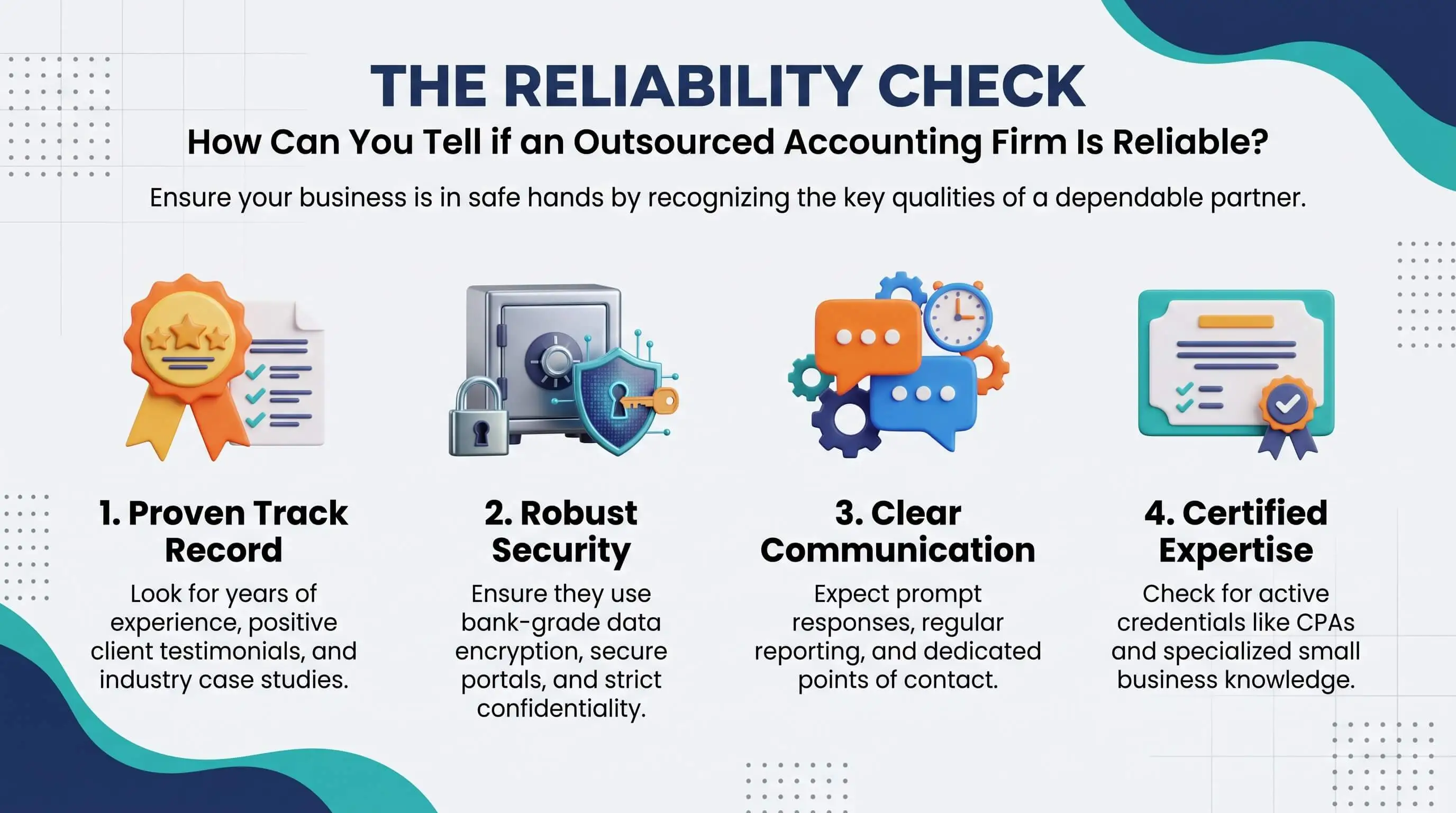
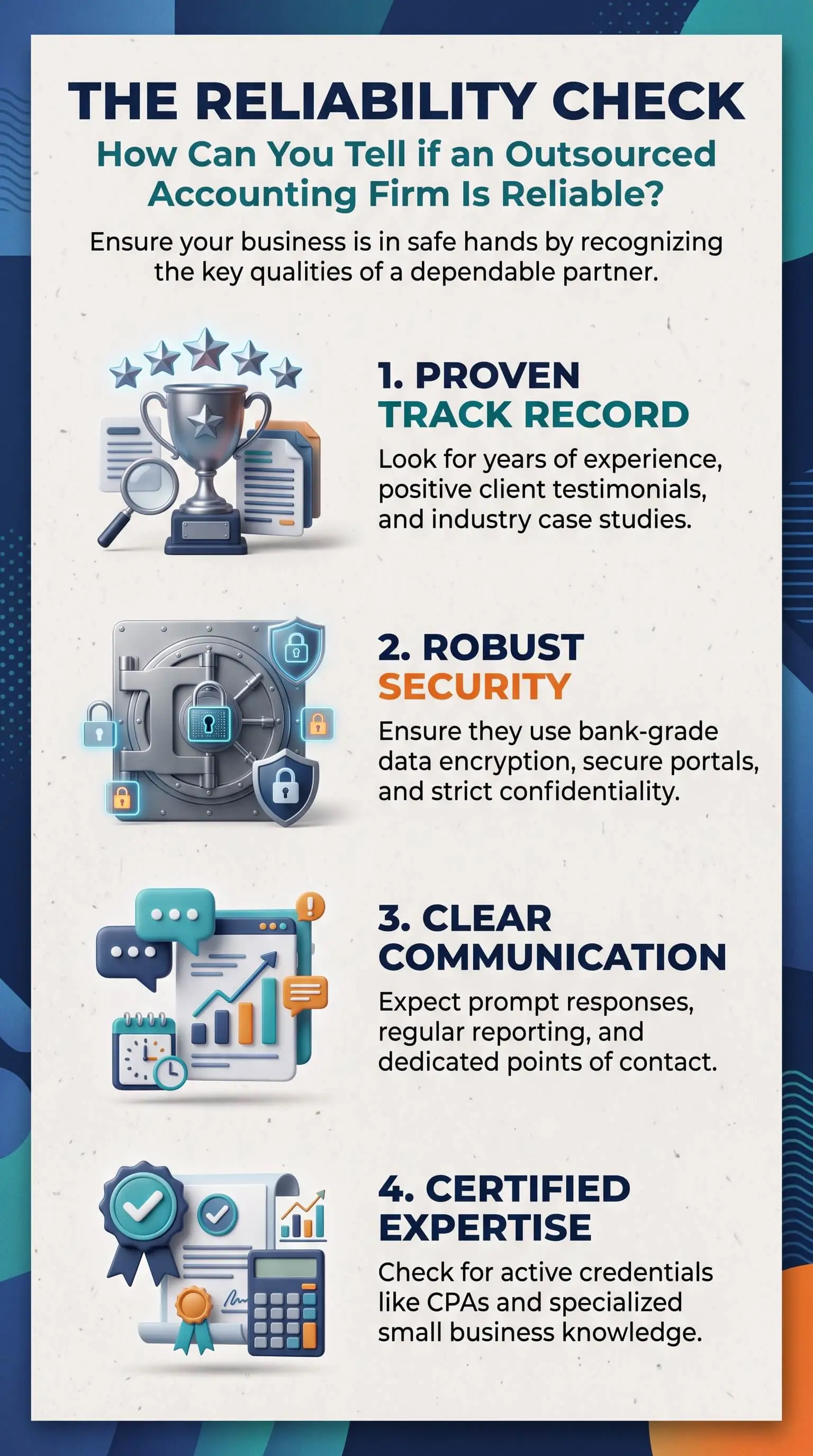
The best outsourced business and financial accounting firms prove their reliability in writing before you sign. Before you choose one, confirm that the firm:
Has a licensed CPA reviewing your books, which you can verify on CPAverify
Puts scope, pricing, and data ownership in a written engagement letter
Delivers reconciled financials by a set business day every month
Uses a separate reviewer on every monthly close
Shows its security practices in writing, ideally with a SOC 2 report
Offers bookkeeping, outsourced accounting, and fractional CFO support so it can grow with you
The simplest test is whether a firm is happy to let you check its work.
Top Takeaways
A dependable firm backs its promises with names and dates you can hold it to.
Checking a CPA's license on CPAverify or your state board takes about five minutes.
A monthly close date the firm actually hits is the clearest everyday sign you chose well.
Ask for security practices in writing, along with a plan for returning your data if you leave.
A separate reviewer on every close catches errors and makes fraud much harder to hide.
Your first 90 days will confirm or disprove everything you heard before signing.
8 Signs of a Reliable Outsourced Accounting Firm
Every sign below is something you can test before you commit, and most take only a few minutes.
1. Credentials You Can Look Up Yourself
Bookkeepers don't need a license. Any firm that prepares financial statements or gives accounting advice, though, should have a CPA overseeing the work, so ask for that person's name and licensing state.
Then look them up on CPAverify or your state board of accountancy. The search takes a few minutes and shows whether the license is active.
2. A Written Scope and Engagement Letter
A dependable firm writes everything down, from what you'll receive each month to who owns your data if you part ways.
Ask for a sample engagement letter before the first call wraps up. Hesitation tells you something.
3. Pricing You Can Predict
You should know what you'll pay each month and what would push that number up. A good firm quotes catch-up work on past-due books separately instead of tucking it into the monthly fee.
Try asking, "What would make my bill go up?" You want an answer in a sentence or two.
4. A Monthly Close Date They Hit
On-time numbers are the clearest everyday sign of a dependable firm. Strong firms commit to delivering reconciled books and financial statements by a specific business day each month.
Ask what day current clients get their financials. When you call a reference, ask whether the firm keeps that date.
5. Security Practices in Writing
Your accounting firm will have access to your bank feeds and payroll, which is about as sensitive as business data gets. Look for multi-factor authentication and tight limits on who can open your accounts, plus a written security summary or SOC 2 report. The firm should also explain how it will return your files and logins if you leave.
"We use the cloud" doesn't count as an answer.
6. A Second Set of Eyes on Every Close
Mistakes slip through when the same person prepares the work and approves it. We'd look for a firm where a preparer does the work and a separate, more senior reviewer signs off.
Ask who reviews your monthly close and how the team catches and logs errors.
7. Experience With Businesses Like Yours
A firm that already serves coaches, agencies, or nonprofits understands irregular income and grant reporting, along with the quirks of online payment platforms. You won't pay them to learn your business.
Ask for two references with a similar size and business model, then call them.
8. One Named Contact Who Responds
You should know who to email and how fast they'll reply. A standing monthly check-in to walk through your numbers is a good sign, too.
Watch how quickly and clearly the firm responds during the sales process. That's usually its best behavior.
Reliable Signs vs. Red Flags at a Glance
Use this list as a quick filter when you compare firms side by side.
A reliable firm names the CPA who reviews your work. Vague talk about "certified experts" is a red flag.
You get a written scope and engagement letter, while a risky firm hands you a sales deck and a verbal summary.
Pricing comes with an explanation of what changes it. Be wary of any firm that stays vague on fees until after you sign.
The firm commits to a monthly close date instead of promising reports "soon."
Security practices arrive in writing. If a firm can't explain where your data lives, walk away.
A separate reviewer checks every close, so one person never does everything.
References you can call beat anonymous praise every time.
Good firms let you take your time. A discount that expires today is a pressure tactic.
Questions to Ask Before You Sign
Bring these to every intro call:
Who will do my work, and who reviews it?
What day will I get my monthly financials?
What does the fee include, and what costs extra?
How do you store and protect my financial data?
What happens to my files and logins if I leave?
Do you carry professional liability insurance?
Which clients like mine can I talk to?
Can we start with a cleanup project or a trial month?
How to Compare Your Shortlist
Once you're down to two or three options, compare them on what you can see rather than what you hear. When you're weighing the best outsourced business and financial accounting firms, look for the proof strong providers publish on their own websites, such as a pricing page, named team members, and client case studies. It also helps when a firm clearly separates bookkeeping from outsourced accounting and fractional CFO support.
Then hold each firm up against the eight signs. The firm that answers every question in writing, without rushing you, usually keeps delivering after you sign.
The 30/60/90-Day Reliability Test
Careful vetting only gets you so far. The first three months show whether you chose well.
By day 30, the firm should have finished onboarding, set up secure access to your accounts, and delivered your first reconciliations.
By day 60, your first full monthly close should arrive on the promised date, and the team should answer your questions inside the response window it gave you.
By day 90, expect a review meeting that explains what your numbers mean for your next decisions.
If you're adding strategic support too, here's what the first month with a fractional CFO usually looks like.
"The firms that let clients down rarely look shaky on the first call. They're friendly and quick, and they sound sure of themselves. You find out who they really are when you ask for something in writing. I've taken over books where the last provider had no engagement letter and no close date, with one person doing everything, so nobody noticed the reconciliations had stopped months earlier. The cleanup cost more than a year of good accounting would have. So I tell every owner to ask two things. What day will I get my numbers, and who checks them? A firm that answers right away and then hits that date every month is the one that lets you stop worrying about the books."
7 Essential Resources
Each of these is free, and each one helps you check a firm's claims instead of taking them on faith.
CPAverify from NASBA is the official national database of licensed CPAs, drawing on 53 participating jurisdictions. Use it to confirm that whoever reviews your books holds an active license.
IRS: Quick Tips for Picking a Tax Pro is the IRS's own short checklist, covering availability after filing season and fee red flags. It also reminds you that you stay responsible for your return no matter who prepares it.
AICPA & CIMA: SOC Suite of Services explains what SOC reports are and why they matter when you outsource. Read it before you ask a firm about security, so you know what a good answer sounds like.
Journal of Accountancy: Promises of "Fast and Easy" Threaten SOC Credibility is a 2026 piece on why a SOC report is only as trustworthy as the auditor behind it. Keep it in mind before you accept any security badge at face value.
FTC: Start With Security, A Guide for Business boils the FTC's data security cases down to ten plain lessons. One of them is about holding service providers to your security standards, which is exactly what you're doing with an accounting firm.
U.S. Chamber of Commerce CO-: How to Decide Whether to Outsource Accounting Services gathers advice from two Crowe partners on when to outsource and what to look for, including industry expertise and data protection.
7 Signs Your Small Business Should Outsource Accounting Instead of Hiring Staff is a good place to start if you're still weighing whether outsourcing fits your business at all.
3 Statistics
The Association of Certified Fraud Examiners' 2024 Report to the Nations found that more than half of occupational fraud cases happened because an organization lacked internal controls or someone overrode them. A separate reviewer on every monthly close is one of those controls, and it's the one that catches what a single person working alone would miss.
According to Verizon's 2025 Data Breach Investigations Report, third-party involvement in data breaches doubled to 30% in a single year. Once a provider holds your bank feeds and payroll, its security habits become yours.
More than half of taxpayers pay a professional to prepare their return, yet the IRS still holds the taxpayer responsible for everything on it. Your books work the same way. You can hand off the work, but the accountability stays with you, so you need a firm whose accuracy you can check.
Choosing the right outsourced accounting firm for small businesses means looking beyond price to strong internal controls, secure financial data practices, and reliable review processes that help protect accuracy and accountability.
Final Thoughts and Opinion
Here's where we land after watching a lot of small businesses make this call. The most reliable outsourced accounting firm is the one that's happy to let you check its work, and that's rarely the cheapest option or the smoothest pitch.
Firms you can count on welcome hard questions because they've already written down the answers. They'll tell you who reviews your books and what day your finances show up, and they'll walk you through how they protect your data. Shakier firms lean on reassurance instead, and "don't worry, we've got it" is about as specific as it gets.
We'd also push back on the idea that switching firms means you failed. If a provider keeps missing closes or can't tell you who has access to your accounts, moving on is the responsible choice. You hired them for clean books on time.
The owners of black-owned marketing agencies who get the most out of outsourcing treat it like any important hire. They verify first and set expectations in writing, then use the first 90 days as an honest test. That's how you go from stressed and reactive about your finances to structured and confident about them.
Frequently Asked Questions
Is It Safe to Outsource My Accounting?
Yes, as long as the firm can show you how it protects your data. Look for multi-factor authentication, access limited to the people who need it, and a written security summary or SOC report. Get it in writing, too, that your files and logins come back to you if you end the relationship.
What's the Difference Between an Outsourced Bookkeeper and an Outsourced Accounting Firm?
A bookkeeper records and categorizes your transactions. An outsourced accounting firm goes further, reconciling your accounts and producing monthly financial statements that a second person reviews. Many also add tax coordination or fractional CFO planning. Any firm giving accounting advice should have a licensed CPA overseeing the work.
How Much Does a Reliable Outsourced Accounting Firm Cost?
Price depends mostly on your transaction volume and how much support you need. Plenty of firms charge a flat monthly fee by tier. A reliable firm spells out what's included, quotes any cleanup work separately, and tells you up front what would change the price.
How Do I Verify an Accountant's CPA License?
Get the reviewer's full name and the state that licensed them. Search for them on CPAverify, NASBA's free national database, or on your state board of accountancy's site. You'll see whether the license is active and whether the board has noted any disciplinary action.
How Long Before I Know an Outsourced Accounting Firm Is Working?
Give it about 90 days. The firm should finish onboarding and your first reconciliations by day 30, then deliver a full monthly close on the promised date by day 60. By day 90, your review meeting should explain what the numbers mean for your next decisions.
Find a Firm That Gets Your Business
Pick three outsourced accounting firms and book a 30-minute intro call with each. Bring the questions above and notice which firm answers clearly and in writing, without rushing you. You should walk away from that conversation with clarity, and the right partner makes that easy.
Still deciding whether outsourcing fits your business at all? Start with 7 Signs Your Small Business Should Outsource Accounting Instead of Hiring Staff, then come back to this checklist when you're ready to compare providers.