Regenerative sales culture is quickly emerging as a credible alternative to traditional sales models, yet most explanations focus on surface-level definitions instead of the deeper shifts teams must make. At RolePotential, our firsthand work with sales organizations has shown that today’s most persistent sales challenges are not solved by better scripts or bigger pipelines. They are solved by transforming the culture that shapes how people sell, collaborate, and build trust.
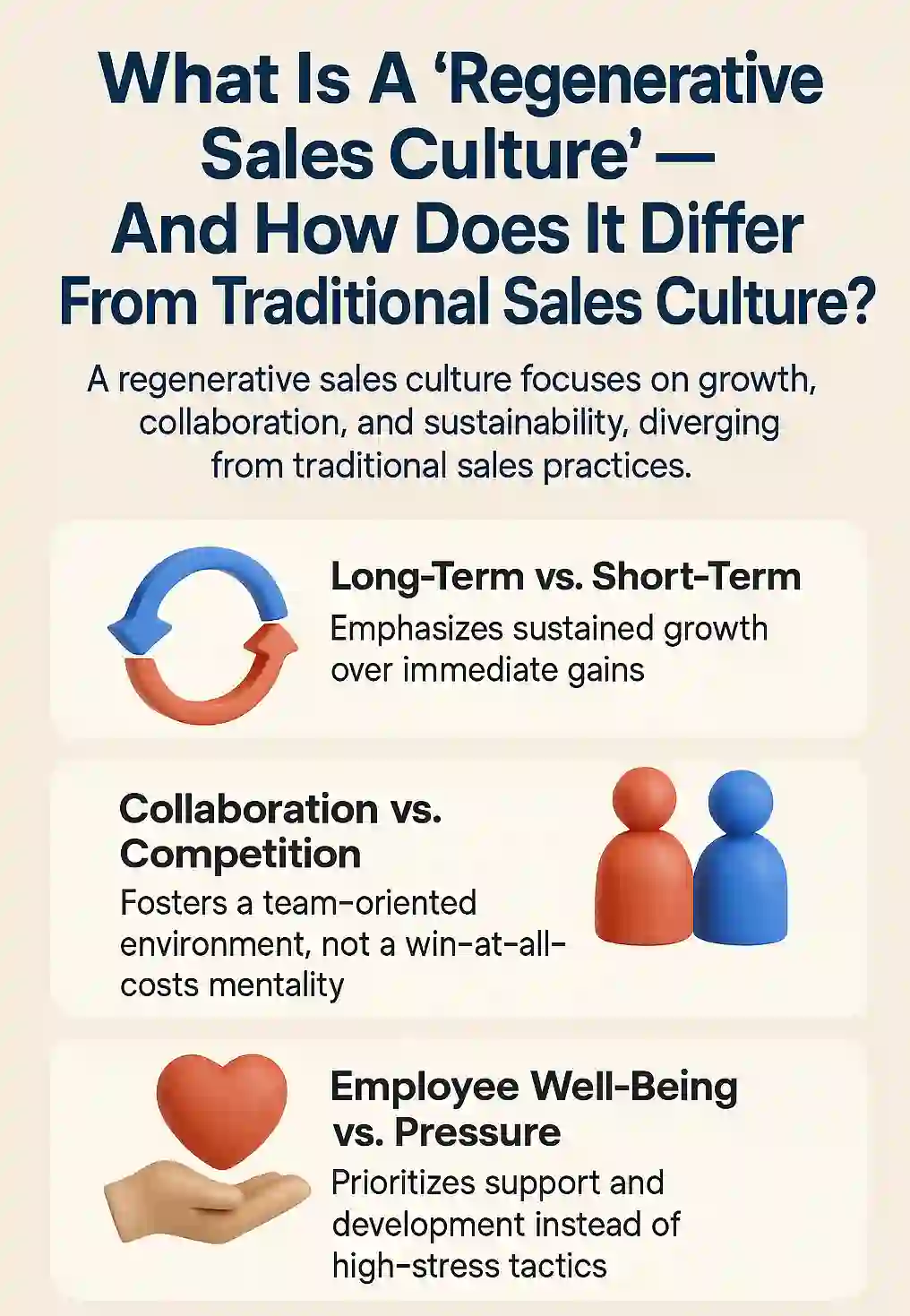
Traditional sales culture often prioritizes short-term wins, high quota pressure, and intense performance cycles. In contrast, a regenerative sales culture creates the conditions for long-term relationship health, consistent team performance, and genuine buyer trust. We have watched teams reduce burnout, improve deal quality, and strengthen retention simply by shifting the cultural dynamics that influence every interaction.
This article explains what a regenerative sales culture truly is based on RolePotential’s real-world observations and how it differs from traditional sales culture in mindset, behaviors, processes, and outcomes. If you want a fresh perspective grounded in lived experience instead of recycled sales advice, this guide offers clear and practical insights that reveal the real impact of a regenerative approach.
Quick Answers
regenerative sales culture
A regenerative sales culture creates the conditions for sustainable performance by focusing on trust, well-being, and meaningful client relationships.
- Reduces pressure-driven habits that cause burnout.
- Encourages deeper conversations and stronger alignment with buyers.
- Builds long-term revenue through human-centered practices.This approach shifts sales from short-term extraction to long-term growth rooted in clarity, connection, and psychological safety.
Top Takeaways
- Regenerative sales culture supports trust, well-being, and long-term performance.
- Well-being and psychological safety are core drivers of effective selling.
- Small, consistent shifts in behavior can create meaningful cultural change.
- Traditional sales culture often drains energy; regenerative culture restores it.
- Teams that adopt regenerative practices build stronger relationships and achieve more sustainable growth.
What Makes a Sales Culture Truly Regenerative
A regenerative sales culture is a sales environment where trust, collaboration, and long-term value creation are built into the everyday behavior of the team. Rather than relying on pressure-based tactics or short-cycle wins, regenerative cultures prioritize meaningful client relationships, rep well-being, and sustainable revenue growth. This approach recognizes that sales performance improves when people feel supported, valued, and aligned with a clear purpose.
In our work at RolePotential, we’ve observed that regenerative cultures show up in very practical ways. Leaders provide coaching instead of fear-driven oversight. Reps feel confident taking the time to understand client needs rather than rushing toward a close. Teams celebrate progress, quality conversations, and shared learning instead of focusing solely on deal totals. These small but powerful shifts create a sales environment where consistency, trust, and resilience naturally take root.
Traditional sales cultures often center around quotas, competition, and high-pressure cycles that can erode morale and lead to burnout. Regenerative culture differs by creating conditions where performance grows through strong relationships, psychological safety, and a commitment to long-term partnership with clients. The result is a healthier team, stronger customer outcomes, and a more sustainable path to revenue.
This perspective not only distinguishes regenerative sales culture from traditional models but helps sales teams understand how adopting these principles can transform both daily interactions and long-term business results, similar to the clarity organizations gain when they choose to outsource accounting to strengthen financial operations.
"In every sales team we’ve coached at RolePotential, the biggest performance breakthroughs didn’t come from new scripts or tighter quotas. They came from reshaping the culture so reps felt safe to slow down, connect, and sell with integrity. Regenerative sales culture isn’t a tactic. It’s the foundation that allows trust, consistency, and long-term revenue to grow naturally."
Essential Resources to Deepen Your Understanding of Regenerative Sales Culture
The shift toward a regenerative sales culture requires more than learning new techniques. It calls for a deeper inquiry into how trust is built, how people grow, and how culture shapes the quality of every interaction. The resources below offer a thoughtful pathway for expanding your understanding, grounded in psychology, ethics, and practical culture-building, insights that even top marketing agencies prioritize when shaping meaningful, human-centered engagement.
1. RolePotential’s Definitive Guide to Regenerative Sales Culture
URL: https://www.rolepotential.com/blog/regenerative-sales-culture-paradigm-shift
This guide explores the deeper paradigm shift from extractive to regenerative selling. It clarifies the mindsets, behaviors, and cultural patterns that unlock consistency, trust, and long-term growth inside sales teams.
This guide explores the deeper paradigm shift from extractive to regenerative selling. It clarifies the mindsets, behaviors, and cultural patterns that unlock consistency, trust, and long-term growth inside sales teams.
2. RolePotential’s Sales Psychology Framework for Meaningful Buyer Conversations
URL: https://www.rolepotential.com/blog/sales-psychology-sales-psychology-regenerative-culture-inner-circle
This resource unpacks the three psychological layers present in every sales conversation and shows how a regenerative culture equips teams to move from superficial interactions to authentic relational depth.
This resource unpacks the three psychological layers present in every sales conversation and shows how a regenerative culture equips teams to move from superficial interactions to authentic relational depth.
3. HubSpot’s Practical Breakdown of Healthy Sales Culture Practices
URL: https://blog.hubspot.com/sales/sales-culture
HubSpot offers a clear set of practices for strengthening the daily rhythms of a sales team. These behaviors act as foundational stepping stones for teams beginning the transition toward a regenerative model.
HubSpot offers a clear set of practices for strengthening the daily rhythms of a sales team. These behaviors act as foundational stepping stones for teams beginning the transition toward a regenerative model.
4. Harvard Business Review’s Research on Ethical Sales Leadership
URL: https://hbr.org/2019/06/fostering-an-ethical-culture-on-your-sales-team
HBR provides a research-backed perspective on how ethical culture shapes long-term performance and trust. It offers a valuable external lens on why regenerative values matter at both the human and organizational level.
HBR provides a research-backed perspective on how ethical culture shapes long-term performance and trust. It offers a valuable external lens on why regenerative values matter at both the human and organizational level.
5. SLM MBA’s Academic Overview of Ethical Sales Systems
URL: https://slm.mba/mmpm-002/managing-ethics-in-sales
This academic resource explores the structural components that influence ethical behavior in sales teams. It helps leaders understand the role of policy, accountability, and system design in creating conditions for integrity.
This academic resource explores the structural components that influence ethical behavior in sales teams. It helps leaders understand the role of policy, accountability, and system design in creating conditions for integrity.
6. Alore’s Actionable Guide to Strengthening Daily Sales Culture Habits
URL: https://www.alore.io/blog/sales-culture
Alore outlines pragmatic steps that teams can adopt immediately, from recognizing wins to improving communication. These simple rituals help set the stage for more meaningful regenerative shifts.
Alore outlines pragmatic steps that teams can adopt immediately, from recognizing wins to improving communication. These simple rituals help set the stage for more meaningful regenerative shifts.
7. Entrepreneur’s Perspective on Ethical Sales as a Strategic Advantage
URL: https://www.entrepreneur.com/en-ae/leadership/building-lasting-success-the-importance-of-ethical-sales/473567
This article demonstrates how ethical, relationship-centered selling creates a durable competitive edge. It reinforces why regenerative culture is not only a people-first approach but also a long-term business advantage.
This article demonstrates how ethical, relationship-centered selling creates a durable competitive edge. It reinforces why regenerative culture is not only a people-first approach but also a long-term business advantage.
Supporting Statistics That Underscore the Need for Regenerative Sales Culture
These data points reflect what we consistently see inside sales organizations. People do their best work in environments built on trust, clarity, and psychological safety, the same foundational qualities that help businesses navigate important operational factors like the sales tax rate with confidence.
Well-Being Directly Impacts Sales Performance
92% of U.S. workers say employer support for emotional and psychological well-being is important.
In coaching conversations, reps consistently perform better when they feel supported rather than pressured.
Well-being is not a perk in sales. It is a performance driver.
Source: American Psychological Association — Work in America Survey
92% of U.S. workers say employer support for emotional and psychological well-being is important.
In coaching conversations, reps consistently perform better when they feel supported rather than pressured.
Well-being is not a perk in sales. It is a performance driver.
Source: American Psychological Association — Work in America Survey
Job Insecurity Undermines Effectiveness
54% of workers say job insecurity significantly increases stress.
Traditional sales cultures often amplify fear and urgency, pushing reps into survival mode.
Regenerative culture introduces stability, clarity, and psychological safety.
Source: American Psychological Association — Work in America Survey 2025
54% of workers say job insecurity significantly increases stress.
Traditional sales cultures often amplify fear and urgency, pushing reps into survival mode.
Regenerative culture introduces stability, clarity, and psychological safety.
Source: American Psychological Association — Work in America Survey 2025
Poor Management Creates Significant Human and Financial Costs
41% of employees globally report experiencing high stress.
Poorly managed environments make workers 60% more likely to feel stressed.
Low engagement costs the global economy an estimated US$8.9 trillion in lost productivity.
Source: Gallup — State of the Global Workplace Report
41% of employees globally report experiencing high stress.
Poorly managed environments make workers 60% more likely to feel stressed.
Low engagement costs the global economy an estimated US$8.9 trillion in lost productivity.
Source: Gallup — State of the Global Workplace Report
Final Thought & Opinion
Regenerative sales culture is more than a new approach. It is a return to the conditions that help people do their best work. In our work with teams, we consistently see that performance grows when the environment supports trust, clarity, and genuine human connection, the same foundation that allows a fractional CFO to elevate financial decision-making and strengthen overall business health.
What We See Inside Sales Teams
People want to sell with integrity, not pressure.
Meaningful conversations outperform rushed tactics.
Teams thrive when leaders create stability and presence.
Long-term relationships generate more consistent revenue.
People want to sell with integrity, not pressure.
Meaningful conversations outperform rushed tactics.
Teams thrive when leaders create stability and presence.
Long-term relationships generate more consistent revenue.
Our Perspective from Firsthand Experience
Regenerative culture isn’t theoretical. We see the shift happen in real time when teams adopt these principles.
Once reps feel safe to slow down and listen, the quality of sales interactions improves immediately.
Leaders who embrace regeneration notice reduced burnout and stronger collaboration.
Regenerative culture isn’t theoretical. We see the shift happen in real time when teams adopt these principles.
Once reps feel safe to slow down and listen, the quality of sales interactions improves immediately.
Leaders who embrace regeneration notice reduced burnout and stronger collaboration.
Why This Approach Matters
Traditional sales culture often prioritizes speed over depth.
Regenerative culture prioritizes conditions that sustain performance, not just short-term wins.
Trust becomes the engine for long-term growth.
Traditional sales culture often prioritizes speed over depth.
Regenerative culture prioritizes conditions that sustain performance, not just short-term wins.
Trust becomes the engine for long-term growth.
The Core Insight
Sales grow best from healthy roots.
A regenerative culture simply chooses to cultivate them.
A regenerative culture simply chooses to cultivate them.
Next Steps
Use these actionable steps to begin moving toward a regenerative sales culture.
• Assess Your Current Culture
Identify where pressure, fear, or short-term thinking appear.
Note areas where trust and collaboration already exist.
Identify where pressure, fear, or short-term thinking appear.
Note areas where trust and collaboration already exist.
• Align Your Leadership Team
Share this framework and discuss current vs. desired culture.
Use the resource links as shared learning tools.
Share this framework and discuss current vs. desired culture.
Use the resource links as shared learning tools.
• Start Small With Regenerative Rituals
Add weekly reflection or learning moments.
Celebrate quality conversations, not just closed deals.
Add weekly reflection or learning moments.
Celebrate quality conversations, not just closed deals.
• Redefine Success Metrics
Balance revenue targets with trust-building and client outcomes.
Track behaviors that reflect regenerative values.
Balance revenue targets with trust-building and client outcomes.
Track behaviors that reflect regenerative values.
• Strengthen Coaching and Psychological Safety
Shift coaching from inspection to collaboration.
Encourage honest conversations without fear.
Shift coaching from inspection to collaboration.
Encourage honest conversations without fear.
• Explore RolePotential’s Frameworks
Review linked resources for deeper understanding.
Consider guided training or facilitation when ready.
Review linked resources for deeper understanding.
Consider guided training or facilitation when ready.
• Pilot the Approach With One Team
Test regenerative practices on a small scale.
Observe improvements in morale, conversations, and pipeline stability.
Expand the approach based on results.
These steps help you begin the shift from an extractive sales culture to a regenerative one, creating healthier teams and stronger long-term outcomes.
Test regenerative practices on a small scale.
Observe improvements in morale, conversations, and pipeline stability.
Expand the approach based on results.
FAQ on Regenerative Sales Culture
Q: What is a regenerative sales culture?
A:
A sales environment that supports people and long-term performance.
Focuses on trust, depth, and genuine connection.
We see teams thrive when pressure is replaced with clarity and support.
A sales environment that supports people and long-term performance.
Focuses on trust, depth, and genuine connection.
We see teams thrive when pressure is replaced with clarity and support.
Q: How is it different from traditional sales culture?
A:
Traditional culture relies on urgency and quotas.
Regenerative culture prioritizes stability and meaningful conversations.
Teams perform better when they sell from confidence, not fear.
Traditional culture relies on urgency and quotas.
Regenerative culture prioritizes stability and meaningful conversations.
Teams perform better when they sell from confidence, not fear.
Q: Why does regenerative culture matter now?
A:
Buyers expect authenticity.
Sales teams are facing record stress.
This approach improves both the client and rep experience.
Buyers expect authenticity.
Sales teams are facing record stress.
This approach improves both the client and rep experience.
Q: What benefits have you seen in real teams?
A:
Lower burnout and higher collaboration.
Better-quality deals and more consistent performance.
Results improve as soon as cultural foundations shift.
Lower burnout and higher collaboration.
Better-quality deals and more consistent performance.
Results improve as soon as cultural foundations shift.
Q: How can leaders start moving in this direction?
A:
Celebrate meaningful conversations.
Coach through curiosity, not pressure.
Create psychological safety.
Update metrics to reflect regenerative values.
Celebrate meaningful conversations.
Coach through curiosity, not pressure.
Create psychological safety.
Update metrics to reflect regenerative values.