If that sounds familiar, IFS therapy may be a good fit. It tends to help people who feel at odds with themselves, whether that's a critic who won't quit or perfectionism that runs whether you want it to or not. It asks for patience. And for some people, including those living with psychosis or certain dissociative conditions, it usually isn't the right place to start.
Internal Family Systems begins with the part that's pulling the brake. Instead of overruling it, you get curious about what it's been protecting all this time.
TL;DR Quick Answers
IFS Therapy
IFS therapy, short for Internal Family Systems therapy, is a talk therapy that helps you get to know the different parts of yourself instead of fighting them. Richard Schwartz developed it in the 1980s.
How it works: You learn to notice which part is speaking, like an anxious planner or a harsh critic, and ask what it's been protecting.
The core idea: Beneath your parts sits a calm center called Self. Nothing about you needs fixing, and even your harshest part is usually trying to keep you safe.
Who it helps: People dealing with inner conflict, self-criticism, perfectionism, anxiety, or older hurt. It's usually not the first choice for psychosis or certain dissociative conditions.
What to expect: Slow, client-led sessions in person or over telehealth. Going slowly is what keeps the work safe.
The evidence: Promising but young, built on pilot studies and a first randomized trial for PTSD.
Top Takeaways
IFS Fits People Who Feel At Odds With Themselves. A loud inner critic, perfectionism on autopilot, and habits you can't drop are the clearest signs.
Slow Is The Method, Not A Delay. IFS therapy works best when you can tolerate going gently, and rushing is where the risk lives.
Some People Should Start Somewhere Else. Schizophrenia, dissociative identity disorder, borderline personality disorder, and active crisis usually call for a different first step.
The Evidence Is Encouraging But Young. Pilot studies and a first randomized trial look promising, and larger trials are still to come.
A Consult Call Tells You What An Article Can't. Fifteen minutes with a trained therapist will answer more than any checklist.
What IFS Therapy Is, In One Minute
Richard Schwartz, a family therapist, built Internal Family Systems in the 1980s after his clients kept describing themselves in the plural. A part of me wants to leave. Another part is terrified too. IFS therapy takes that language at face value and helps you get to know each side instead of arguing with it.
Most parts fall into a few rough groups:
Managers plan, check, and stay two steps ahead so nothing goes wrong.
Firefighters show up fast when something hurts, usually through numbing, snapping, scrolling for two hours, or pouring the second glass.
Exiles hold the older hurt, the other two work so hard to keep quiet.
Underneath them, the model says, sits a steadier center called Self. It's the part of you that can listen without panicking, and most people have felt it at least briefly. Therapy helps it lead more often.
If you've spent time around coaching, the difference is worth knowing. As this site's piece on how a life coach differs from a therapist explains, coaching works on goals and the behavior that gets you there. IFS works with whichever part of you keeps resisting the goal, even when you want it badly.
Signs IFS Therapy May Be A Good Fit For You
You don't need a diagnosis to wonder about this. Most people asking the question are carrying something they can't quite name yet, so read the list slowly and notice which lines land.
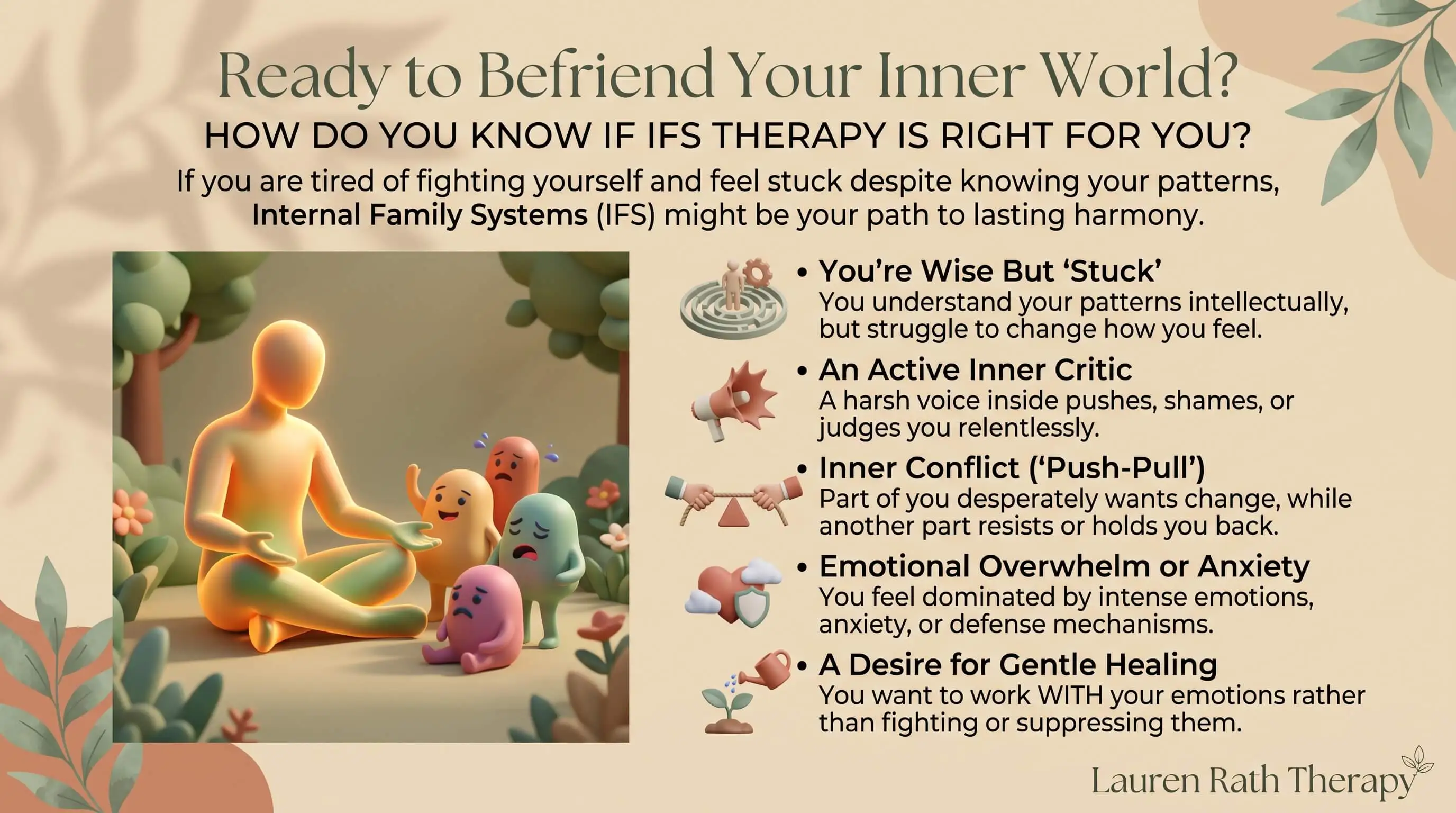
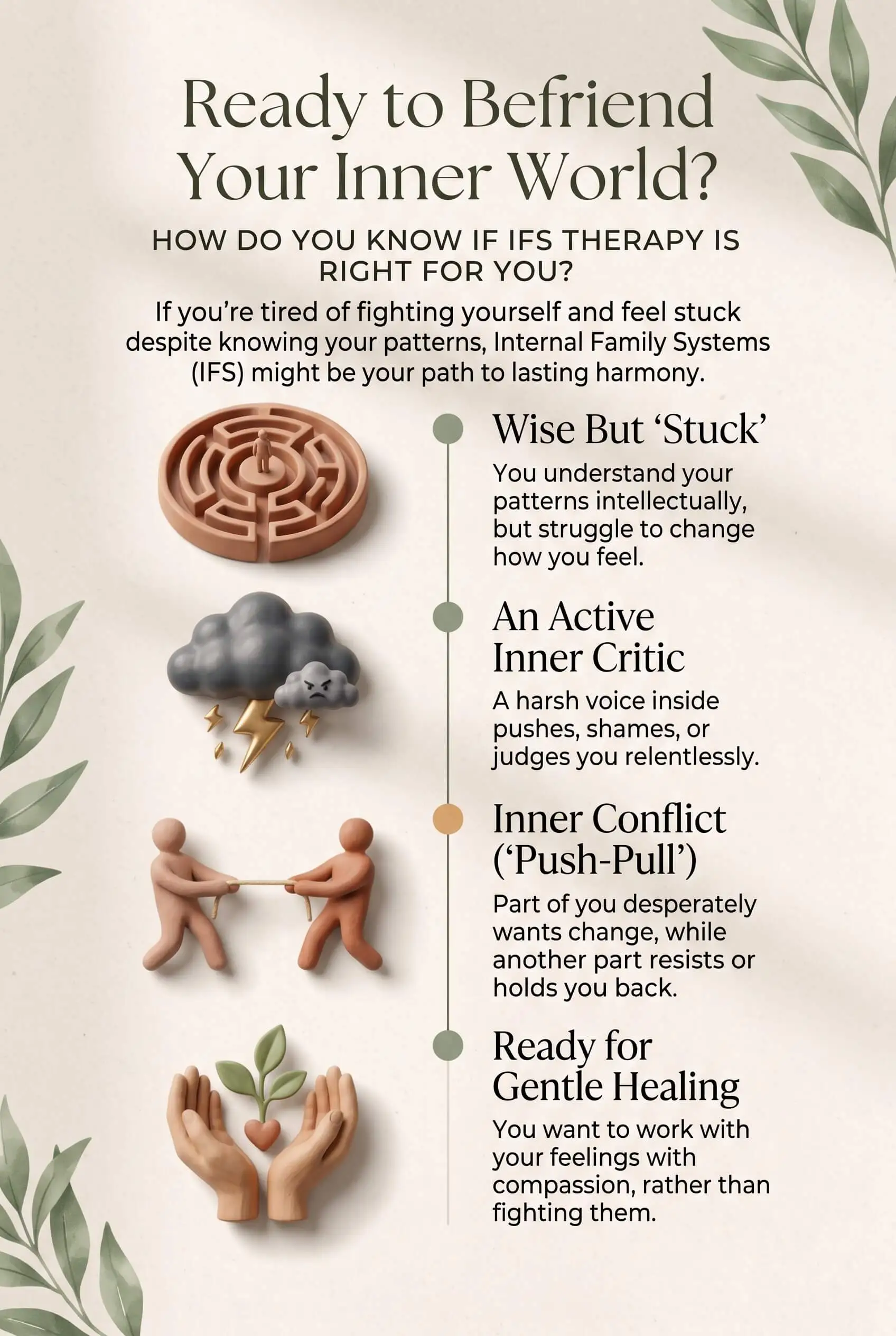
You argue with an inner critic. It talks through dinner and most of the drive home, and telling it to stop has never worked. Lauren Rath, an IFS-trained therapist, calls it the part people most want gone, and almost always a protector.
Big decisions pull you two ways at once. Stay or go, say yes or guard your time, and both sides feel true.
Perfectionism or pleasing people runs on autopilot. You check the email four times before sending. You agree before you've actually decided.
Some coping habits won't budge. The scrolling, the overworking, the shutdown when a conversation gets tense.
Therapy helped before, but only so far. You understand your patterns, and understanding hasn't moved them.
You're curious about your inner life. You'd like to know it better without analyzing it to death.
You can tolerate going slowly. This one matters more than anything else on the list.
If three or more of those sound familiar, a consult call with a trained IFS therapist is a reasonable next step. You don't need anything more than that to begin.
When IFS Therapy May Not Be The Right Place To Start
IFS therapy isn't for everyone, and you deserve to hear that before you book anything.
Certain conditions call for a different first step. Healthline's medically reviewed guide says IFS is generally not recommended for people with schizophrenia, dissociative identity disorder, or borderline personality disorder, since the focus on sub-personalities may deepen confusion or dissociation. Make that call with a licensed clinician, not a blog post.
You're in crisis right now. Getting stable comes first, and parts work can wait.
You want a structured skills plan with homework. CBT may suit you better, at least to start.
You need fast results. IFS rarely delivers them. A therapist who promises otherwise is a good reason to keep looking.
The criticism deserves a fair hearing too. In October 2025, New York Magazine's The Cut published an investigation in which former patients said aggressive parts work harmed them. The IFS Institute disputed the pseudoscience label and said the practices described broke the model's own safety rules. The risk is real, and in careful IFS work, slow pacing is what guards against it.
How IFS Therapy Compares To CBT, EMDR, And Coaching
Each approach asks something different of you.
IFS therapy works with the relationships between your parts and Self, at a slow pace you largely set. People often come to it for inner conflict, self-criticism, or older hurt. Its research base is growing but still leans on pilot studies and a few early trials.
CBT targets present-day thoughts and behaviors, usually in a structured, time-limited format with homework. It has the deepest research base of the four and a strong record with anxiety and depression.
EMDR processes specific traumatic memories in phases. For PTSD, the evidence behind it is strong.
Life coaching is about goals, accountability, and forward motion in areas like career and habits. It isn't a mental health treatment, and research on it is thin.
None of these rule the others out. Plenty of people use coaching for direction and therapy for whatever keeps getting in the way.
What Your First Few IFS Sessions Actually Feel Like
Slower than most people expect, and that's deliberate.
You'll usually start by saying what brought you in, and a sentence or two is plenty. From there, your therapist helps you notice what's happening right now. Maybe your shoulders creep up when a certain name comes up. You pause right there and get curious about it.
The central move is called unblending. You shift from "I am anxious" to "a part of me is anxious," which sounds like a small grammar change until you feel it. Suddenly there's a little room between you and the feeling.
For a fuller walkthrough, here's what an IFS parts work session actually looks like, written by a therapist who does this work every week.
You can test the idea right now. Think of something that's bothered you today and say it two ways: "I'm frustrated," then "a part of me is frustrated." Most people feel something a little on the second version. That's unblending in miniature. This approach can also be useful when navigating stressful decisions, such as working with a private school consultant to explore educational options.
"The question I hear most on a first call isn't whether IFS works. It's 'what if I'm doing it wrong?' That worry is usually a part too, and it tells me a lot about what that person has been carrying. In my experience, the people who do well with this work are rarely the ones with the clearest story. More often they're the ones willing to stay curious when a feeling shows up instead of fixing it on the spot. Thirty seconds of that is enough to begin. And if you can't manage it yet, that's simply where we'd start."
Essential Resources
Seven places to go next, whether you're still weighing it or ready to pick up the phone.
Find A Trained IFS Therapist Near You, Or Online
The IFS Institute keeps a searchable directory of practitioners who've finished at least Level 1 training, with filters for state, training level, certification, and openings. Listings are self-reported, and the Institute says so plainly, so confirm a therapist's license on your first call.
Source: IFS Institute Directory
Read What The Research Does And Doesn't Show
The Institute's own research page is more candid than you might expect. It calls the evidence emerging, names depression as the only condition with significant improvement across multiple pilot trials, and admits the risk of harm hasn't been studied systematically yet.
Source: IFS Institute Research
See The Broadest Review Of IFS Studies So Far
Megan Buys's 2025 scoping review in Clinical Psychologist gathers the peer-reviewed IFS research in one place. She found the approach promising for PTSD, depression, and chronic pain, and called for larger, more rigorous trials before anyone treats it as settled.
Source: Clinical Psychologist, Taylor & Francis
Get A Medically Reviewed Overview, Including Who Should Wait
Healthline's guide, reviewed by psychologist Akilah Reynolds, PhD, covers how IFS works, cost, and the conditions where it's generally not recommended. It's one of the few mainstream pages that puts the controversy right next to the benefits.
Source: Healthline
Hear The IFS Institute's Side Of The 2025 Controversy
The Institute answered New York Magazine's reporting on November 4, 2025. It argues the practices described run against IFS principles and notes the model won't treat recovered memories as fact without corroborating evidence. Read it alongside the original story and judge for yourself.
Source: IFS Institute News
Know What Good Therapy Looks Like Before You Start
The American Psychological Association walks through how therapy works, how long it usually runs, what to ask on a first call, and what to do if it isn't helping. All of it applies whichever approach you end up choosing.
Source: American Psychological Association
Compare IFS With Other Common Therapies
NAMI lays out CBT, DBT, EMDR, psychodynamic therapy, and several others in plain terms with no sales angle. It's a quick way to see where parts work sitting among your options.
Source: National Alliance on Mental Illness
Supporting Statistics
The numbers behind IFS are small but worth knowing, as long as you read them for what they are.
92% Of Pilot Completers No Longer Met PTSD Criteria
Hilary Hodgdon's team enrolled 17 adults with PTSD and histories of multiple childhood traumas in 16 ninety-minute IFS sessions.
Of the 13 who finished, only one still met criteria for PTSD at the end of treatment and at the one-month follow-up. Depression and dissociation dropped as well.
What this means for you: the result is striking, but the study was small and had no comparison group. Take it as a reason to look seriously at IFS rather than a guarantee of anything.
Source: IFS Institute, Hodgdon et al. pilot study
The First Randomized Trial Of A Group IFS Program Enrolled 60 People
Zev Schuman-Olivier's team at Cambridge Health Alliance, a Harvard Medical School affiliate, randomly assigned 60 patients with PTSD to a 16-week IFS-based group program or an active comparison program.
Symptoms dropped substantially in both groups, while the IFS group showed up more often and reported higher satisfaction.
What this means for you: IFS held its own against another active treatment, and people stayed with it. It didn't clearly beat the comparison, and that's what honest early research tends to look like.
Source: IFS Institute Research Milestone
Only About 1 In 10 U.S. Adults Saw A Therapist In A Year
In 2020, 20.3% of U.S. adults received some kind of mental health treatment in the previous 12 months.
16.5% took prescription medication for their mental health.
Just 10.1% received counseling or therapy from a mental health professional.
What this means for you: if you're asking whether IFS fits, you're already further along than most. Plenty of people manage symptoms for years without ever getting a room in which to understand them.
Source: National Center for Health Statistics
Final Thoughts And Opinion
Most advice about change tells you to push harder. IFS therapy asks what the part pushing back has been trying to protect, and for a lot of people that question explains years of stalled effort.
Our honest view includes the parts that don't flatter the model.
IFS Is Promising, Not Proven. The research is real and growing, and it's also mostly small. The IFS Institute says as much. Anyone selling IFS as a sure thing is overselling it.
The Therapist Matters More Than The Label. Training levels vary a lot. A careful, unhurried clinician with Level 1 training may serve you better than a rushed one with a longer list of credentials.
Pace Is The Safety Feature. The 2025 criticism centered on protective parts being pushed aside too fast. Good IFS work moves the other way, so if a therapist rushes you toward old pain, leave.
Coaching And IFS Can Share The Work. A coach keeps you moving toward the goal while IFS helps with whatever keeps grabbing the brake. You don't have to pick one forever.
You Don't Have To Be Sure Before You Ask. Nearly everyone who calls wonders whether they're the right fit, and that uncertainty is a normal place to begin.
If the self-check sounded like you, the next step is small: one conversation, with no commitment attached, whether that's with a therapist or someone from one of the top black-owned marketing agencies navigating similar challenges.
Frequently Asked Questions
Q: Is IFS Therapy Right For Me?
A: It may be if you feel at war with yourself, keep repeating patterns you understand but can't change, or live with a harsh inner critic. You'll also need some patience for a slow pace. If you have psychosis, dissociative identity disorder, or borderline personality disorder, ask a clinician whether another approach should come first.
Q: Does IFS Therapy Work?
A: The early research is encouraging. Pilot studies show improvement in depression and PTSD symptoms, and the first randomized trial of a group IFS program showed large drops in PTSD symptoms. Even so, the IFS Institute describes the evidence as limited and is calling for larger trials.
Q: Is IFS Therapy Evidence Based?
A: Partly. SAMHSA's National Registry of Evidence-based Programs and Practices listed IFS in 2015, though the registry shut down in 2018. According to the IFS Institute, depression is currently the one condition with significant improvement across multiple pilot trials.
Q: Is IFS Therapy Safe?
A: Done slowly by a trained clinician, it carries low risk for most people. The main concern is a therapist pushing past protective parts too fast, which can destabilize someone, especially with complex trauma. The IFS Institute also says harm hasn't been studied systematically yet, so ask any therapist how they handle pacing.
Q: How Long Does IFS Therapy Take?
A: Longer than most people hope, and it varies. Some notice a shift within a handful of sessions, while others work for a year or more. Research programs have often run about 16 weeks, though real life rarely follows a study schedule.
Q: Can You Do IFS Therapy Online?
A: Yes. IFS is conversational and internal, so it adapts well to telehealth. Several IFS research programs run entirely online, and many people find it easier to turn inward from their own room.
Q: Can A Life Coach Do IFS?
A: Some coaches train in IFS-informed coaching, and the IFS Institute offers a program for them. Coaching still isn't therapy, though. If you're working through trauma, depression, or anxiety, look for a licensed therapist with IFS training.
Q: How Is IFS Different From CBT?
A: CBT changes thoughts and behaviors through structure and homework. IFS works with the parts behind those thoughts and asks what each one is protecting. CBT has more research behind it, while IFS often appeals to people for whom insight alone hasn't been enough.
Find Out If IFS Fits, Without Any Pressure
If any of this sounded like you, that's reason enough to make one call. You don't need a tidy story or a diagnosis, only a bit of curiosity.
When you're ready, explore IFS parts work therapy with Lauren Rath Therapy and book a free 15-minute consult. There's no pressure either way.