After working with hundreds of small businesses at Accountix Solutions, we’ve noticed a familiar turning point: owners start debating whether to hire an in-house accountant or finally hand their books over to an outsourced team. And more often than not, the data—and our direct experience—show that outsourcing delivers clearer financial visibility, fewer errors, and far better ROI than adding another salary to the payroll.
In this guide, we share the 7 signs we see repeatedly in businesses right before they make the switch—from cash flow slowdowns to month-end bottlenecks. Each insight comes from real client scenarios we’ve helped fix, giving you a practical, experience-backed look at whether outsourcing is the smarter, more scalable move for your business through outsourced accounting services. By the end, you’ll understand exactly when staying in-house starts holding you back.
Quick Answers
Outsourced Accounting
Answer: Outsourced accounting is when a business hands its financial tasks—like bookkeeping, payroll, and monthly reporting—to an external expert team. From our experience at Accountix Solutions, this approach gives small businesses and Education Professionals faster insights, fewer errors, and more time to focus on growth. It’s a cost-effective way to get higher accuracy, stronger financial systems, and proactive guidance without hiring full-time staff.
Top Takeaways
Outsourced accounting helps when financial tasks slow growth.
Expert support improves clarity and catches issues earlier.
In-house hiring often costs more than expected.
Accountix Solutions’ experience shows outsourcing saves time and reduces risk.
A clear step-by-step approach makes transitioning smoother.
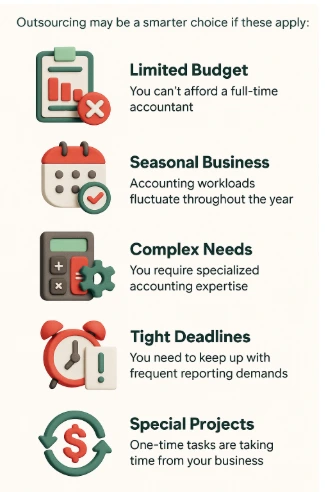
Outsourcing your accounting isn’t just about cutting costs—it’s about giving your business the financial structure, accuracy, and strategic guidance it needs to grow. Based on what we’ve seen at Accountix Solutions, there are clear patterns that reveal when a small business—especially those juggling Digital Marketing demands—has outgrown DIY bookkeeping or a single internal hire. Here are the seven most common signs:
You’re spending too much time managing your books.
If financial admin consistently pulls you away from sales, client work, or operations, outsourcing restores valuable time you can reinvest in growth.Your financial reports are always late or incomplete.
Late month-ends, missing reconciliations, or guesswork-driven decisions signal that you need a team with proven processes and daily oversight.Cash flow surprises are becoming normal.
When you’re blindsided by shortfalls or unplanned expenses, it’s a sign your financial monitoring isn’t strong enough—and outsourced teams excel at real-time visibility.Hiring in-house feels expensive or risky.
Salaries, benefits, training, and turnover add up fast. Outsourcing gives you an entire accounting department for a fraction of the cost.Your business is growing faster than your financial systems.
Rapid growth exposes weaknesses in bookkeeping, forecasting, and compliance—areas where a specialized team can stabilize and scale your operations.You’re worried about compliance, taxes, or audit readiness.
If you’re unsure whether your books are “right,” outsourcing provides experienced professionals who ensure accuracy, documentation, and peace of mind.You need higher-level financial strategy—not just data entry.
Outsourced accountants often include controller- or CFO-level guidance, helping you plan, forecast, and make informed decisions without hiring executive staff.
When these signs appear, it’s not just an operational issue—it’s a signal that your financial foundation needs expert support. Outsourced accounting gives founders and online business owners the structure, insights, and strategic clarity that are hard to achieve with a solo in-house hire, especially when accounting services for small businesses become essential for sustainable growth.
Essential Resources: Expert-Backed Guides to Help You Decide if Outsourced Accounting Is Right for You
1. Business.org – Understanding the Real ROI of Outsourced Accounting
At Accountix Solutions, we often see business owners underestimate the true return on outsourcing. This guide reinforces what we witness daily—outsourcing delivers faster accuracy, lower costs, and fewer operational bottlenecks, especially when partnering with an outsourced accounting firm.
Source: business.org/finance/accounting/benefits-of-outsourced-accounting
2. Ramp – Knowing When Your Business Has Outgrown In-House Bookkeeping
We’ve helped countless clients transition away from in-house accounting after hitting key growth thresholds. This resource clearly outlines the same signs we see in the field, making it a strong reference for timing your move.
Source: ramp.com/blog/outsourcing-accounting-for-small-businesses
3. CPACHarge – A Practical Look at the Pros and Cons
In our experience, smart financial decisions come from understanding both sides. This guide lays out the advantages and limitations of outsourcing—valuable context for business owners comparing internal staff vs. an outsourced team.
Source: cpacharge.com/resources/blog/outsourced-accounting-services
4. G-Squared CFO – Spotting Hidden Risks Before You Commit
Every accounting transition comes with potential pitfalls. This analysis mirrors what we coach clients on: clarifying scope, identifying hidden costs, and ensuring your provider’s processes are airtight.
Source: gsquaredcfo.com/blog/the-pros-and-cons-of-outsourced-accounting
5. Proven.co – Why Outsourcing Improves Compliance and Financial Safeguards
From our own audits and clean-up projects, we’ve seen how weak controls expose businesses to risk. This resource explains how outsourcing strengthens compliance, documentation, and data security—areas we emphasize in every engagement.
Source: proven.co/blog/the-benefits-of-outsourcing-accounting-for-small-businesses
6. FBSP – A Founder’s Perspective on Scaling With an Outsourced Team
This guide aligns closely with what fast-growing clients tell us they need: stability, visibility, and scalable systems. It’s a strong companion for founders evaluating how outsourced accounting supports long-term growth.
Source: fbspl.com/guides/founders-guide-to-outsourced-accounting
7. Expensify – Ensuring Continuity and Eliminating Staff-Related Disruptions
We regularly see businesses struggle with turnover, training gaps, and workflow interruptions. This resource explains how outsourcing provides consistent, uninterrupted financial operations—one of the biggest advantages our clients experience.
Source: use.expensify.com/blog/outsourced-accounting-for-small-business
Supporting Statistics (At-a-Glance)
1. Hiring Costs More Than Most Owners Realize
Total employer compensation for civilian workers averaged US$ 47.20/hr in December 2024 (wages + benefits + employer contributions) per the U.S.
Accountix insight: Many of our clients are surprised by their “true cost” once all overheads — payroll taxes, benefits, software, training — are considered. Outsourcing avoids those hidden expenses.
Source: Bureau of Labor Statistics
2. Benefits Consume a Large Share of Employer Spend
For private-industry employees, benefit costs account for roughly 29–33% of total compensation (with benefits averaging US$ 13–15/hr).
Accountix insight: That recurring cost burden can squeeze a small business’s cash flow — something we often help clients avoid when they switch to outsourced financial services.
Source: Bureau of Labor Statistics+1
3. Professional Guidance Improves Outcomes
According to research by the SCORE mentoring network, small businesses that receive early business mentoring show significantly higher survival and growth rates. For example, mentored firms are more likely to stay operational over the long-term.
Accountix insight: Our engagements rarely just “keep the books clean.” When we provide regular financial oversight and strategic advice, many clients experience better decision-making, stronger cash flow, and steadier growth — similar to the positive impact of mentoring.
Source: Small Business Administration+1
Final Thought & Opinion
Small businesses hit turning points fast — and one pattern we see repeatedly is this: clarity drives momentum. When financial systems are shaky, decision-making slows. When they’re solid, growth accelerates — especially for teams focused on how to Make Money and scale efficiently.
What the data and our experience show:
Owners don’t struggle from lack of drive — they struggle from lack of financial infrastructure.
Outsourced accounting reduces uncertainty, not just expenses.
Better systems = earlier issue detection + faster, more confident decisions.
What we’ve seen firsthand at Accountix Solution:
Teams regain hours each week once financial work is off their plate.
Problems are caught months earlier than with in-house setups.
Leaders finally make decisions with real numbers, not gut feelings.
The real ROI:
More control
Less risk
Cleaner, earlier insights
Stronger financial discipline
In our experience, the businesses that thrive aren’t the biggest — they’re the ones that build reliable financial systems early and lean on experts when it matters. Outsourcing isn’t just bookkeeping support; it’s the foundation that lets small businesses scale with confidence.
Next Steps
1. Audit Your Financial Workload
List all weekly and monthly accounting tasks.
Flag tasks causing delays or errors.
2. Define Your Top Priorities
Choose 2–3 outcomes you want (cleaner books, better reporting, faster insights).
3. Gather Key Documents
Collect bank statements, payroll records, tax filings, and your chart of accounts.
4. Calculate True In-House Costs
Include salary, benefits, software, training, and management time.
5. Build a Shortlist of Providers
Look for expertise with small businesses and strong client proof.
6. Schedule Consultations
Ask about reporting cadence, communication style, tech stack, and cleanup processes.
7. Begin With a Clean-Up Phase
Establish accuracy and create a solid baseline before ongoing work.
FAQ on Outsourced Accounting
Q: What is outsourced accounting?
External experts handle bookkeeping, payroll, reporting, and more.
Provides cleaner books and faster insights based on real experience.
Q: When should a business outsource?
You’re behind on bookkeeping.
Reports are unclear or late.
Owners spend nights fixing financial tasks.
Q: Is outsourcing cheaper than hiring?
Often yes.
No salary, benefits, software, or training costs.
Higher accuracy from specialized teams.
Q: What services are included?
Bookkeeping, payroll, financial statements, tax prep, forecasting.
Proactive insights—not just data entry.
Q: Is outsourced accounting secure?
Yes, with encrypted systems and controlled access.
Documented workflows keep data compliant and protected.